Saturday, 1 May 2010

Andrew Shmidt - Pixar Animation Studios (Part 1 - The Pipeline)


I apologise for the lack of any posts the past month, here at last are the notes from Pixar's Animex presentation by Andrew Shmidt.  The focus of the event was the most recent feature release "Up" which Andrew had animated on. Andrew Shmidt is a senior animator at Pixar and has 20 years of industry experience, initially a 2D animator, Andrew began his career in 1990 at Amblimation Studios working on features such as Fievel Goes West and Balto.  In 1996 he moved to Los Angeles and worked with Dreamworks on projects such as the Prince of Egypt and The Iron Giant. In 2000, Schmidt moved to San Francisco and joined Pixar Animation Studios where he has worked on Monsters, Inc., Finding Nemo, The Incredibles, Ratatouille, Wall-e, Up and Toy Story 3.  He has also animated on various Pixar short films, including supervising animation for Partly Cloudy.


Up, if anyone hasn't watched the film, is the tale of an old man Carl Fredrickson who's promise to fly to paradise falls with his wife was never realised while she was alive.  Carl, adamant he keeps his promise, attaches thousands of party balloons to his house and ventures to South America.  An incredible adventure ensues with a host of memorable characters.  Pete Doctor had his directorial début with Monsters Inc and was director for the 2nd time on Up, the feature was derived from the initial idea of a floating city developed by Bob Peterson a fellow lead animator on Up.  The image of a grumpy old man holding balloons had great contrast and drove pre-production of the project in the interesting direction of an isolated floating house.


There are a few Rules of Reliability that Pixar follow when developing a feature:
  • Tell a compelling story that keeps the audience engaged.
  • Populate the story with memorable characters.
  • Put characters in a believable environment.

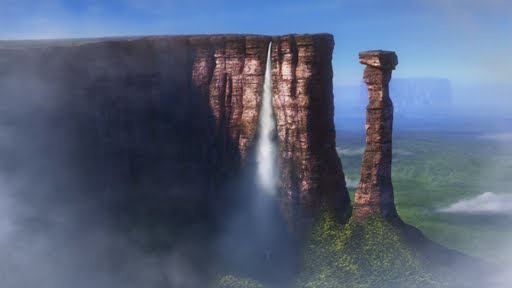
Up is set in the Tepui mountains of South America and the film boasts a fictional exaggerated waterfall called Paradise falls inspired by the Angel Falls.  The Tepui were visited by lead members of the creative team where their personal experiences and first hand perspective of the environment could aid the projects artistic portrayal.  The world of the Tepui held many alien shaped rocks and plants that directly influenced the design of the world and characters in the film.


Once concept art is in great abundance the story is of the main focus and digital storyboards are used to pitch the progress of the narrative.  Andrew brought up a breakdown of the story driven process that is Pixar's production pipeline:
  1. Idea Development, collaborative collection of thoughts gathered for the project across the creative team.
  2. Concept Art, traditional skills such as storytelling, drawing, painting and sculpture are used to communicate ideas, keep things informal and encourage experimentation. (story determines what to put in the film and technology responds)
  3. World, Character, Story, The story process is moved forward by designs for the world and characters of the film. The world has it's own rules, that limit what the character can do, building unique worlds is at the heart of animation. Characters have things they want and need, that push the limits of the world, they should feel like they live beyond the frame of the film.
  4. Design, Everything is design, cycles of planning and implementation are alternated, Pixar avoid "waterfall design" where all design is complete before implementation begins.
  5. Timeline & Departments, A four year design process, planning for all four of those years with Story, Art and Editorial. technological Implementation for the last 2 years involving-
  • Editorial
  • Modelling, Articulation, Shading, Digital Painting
  • Layout, Set Dressing, Animation, Lighting
  • Rendering
     6.  Story, Art & Editorial, 3 departments are the focus of design-
  • Story creates storyboards, drawings that are a comic strip version of the film's important moments.
  • Art creates inspirational images, character and set designs, colourscripts and lighting pastels.
  • Editorial creates story reels, rough drafts of the film made up of storyboard drawings, scratch dialogue and borrowed music.
     7.  Implementation - Objects, Everything in the film,        
  • The shape and surface are created separately for every object.
  • Modelling and Articulation deals with shape and how the shape moves (primarily 3D skills). ---M----Articulation or rigging provides the hinges in the model allowing it to be positioned.
  • Shading and Painting works on surface (primarily 2D skills)
     8.  Shading & Digital Painting,
  • shaders produced to provide surface deformations and colour
  • digital paintings used to rough up textures and add naturalistic detail.
     9.  Shots (Layout, Set Dressing, Lighting), .
  • Layouts set up the basic blocking for character and camera movement, informed by the storyboards and story reel.
  • Set Dressing makes sure each shot is well framed by set and props
  • Lighting lights the shot to focus the action and to help create mood, informed by concept art, colourscripts.
   10. Animation, the rigged character models are put into motion.
  • Animators break down the performance into poses
  • Each pose attempts to capture the character's thoughts and feelings.
   11. Rendering, Final step of Implementation
  • the film consists of roughly 120,000+ rendered frames 
  • layers include- Key lights, shadows, occlusion, character, reflection, irradience, beauty layer
  • all layers are applied to a final composite.
I hope this pipeline has helped shed some light on the Pixar production process, the presentation had a great deal of information to get down on paper so I shall continue with Andrew Schmidt's notes in my next post which will shed more light on the technical detail and inner workings of the studio.

Monday, 29 March 2010

"Extraordinary Tales" - Animated feature (Les Armateurs & Melusine Productions)

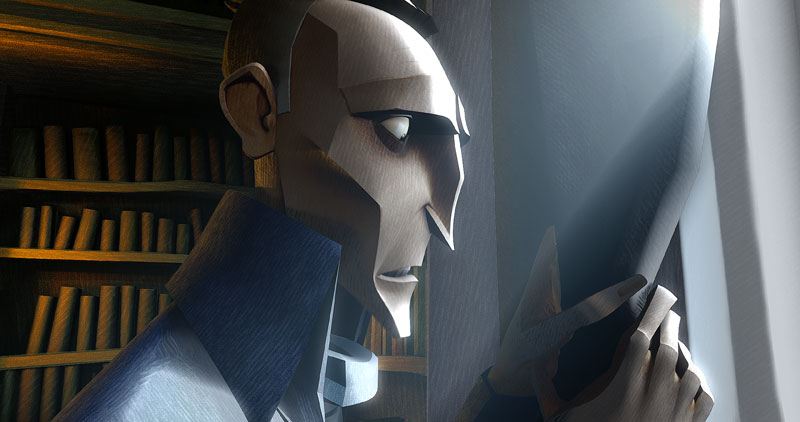
Edgar Allan Poe's literary works have inspired a new animated feature "Extraordinary Tales" directed by Raul Garcia.


Currently in production by Melusine and Les Armatures, the studio responsible for The Belleville Rendezvous,  the film will be made up of 5 adaptations of the writers stories including The Tell Tale Heart.  The few images released so far of the film show a brilliantly distinctive look and indicate that the film may be entirely or at least partly CG so perhaps this could be a mixed media production.


This looks to be a really interesting film, whether this will be released in mainstream cinema or to the Film Festival Circuit is not known yet but I shall definitely keep an eye out for it.

Saturday, 27 March 2010

Michael Defeo - Blue Sky Studios (character development)

The sculptor Michael Defeo talked at Animex 2010 on behalf of Blue Sky studios.
A brilliant artist, Defeo has a great deal of experience in the industry creating the final 3D designs for the infamous Scrat and many other characters including Sid from Ice Age and Horton from Horton Hears a Who.
The talk consisted of a brief description of Michael Defeo's career path and then into the technical aspects of what contributes to a good sculpture and how to approach character when sculpting.


Michael Defeo was heavily influenced by Ray Harry Hausen and this drove him to pursue the art of model making and sculpting. He initially moved into commercial advertising with creation of stop motion puppets.  The founders of Blue Sky started out on the cult hit TRON and many years later created a film called Joe's Appartment featuring singing, dancing cockroaches.  This was Defeo's first big film and he created the stop motion puppets for the feature, this project led to work on the popular Alien film and a CG short named Bunny. That short gained an oscar for best animated short in 1998 and the achievement set the ball rolling for Blue Sky's following features with the Ice Age franchise, Robots and Horton Hears a Who.

So here are the more technical and practical notes, Michael stressed that reference imagery when sculpting is extremely useful and that traditional art should be a constant influence.  Working professionally in this area does mean collaboration with other artists and departments so it is best to expect plenty of limitations and changes to projects and designs at the most aggravating of times, this is the typical influence business has on art.

 When sculpting Michael tries to capture story moments and dynamic poses to give a high level of expression to the characters. With these poses contrasting curves are best so that the sculpt attains a good composition.  Developing the 3D forms requires an understanding of the hierarchy of forms, meaning seeing planes in the cross sections of the characters shape.  Starting with the general planes allows a block out of the form which which can then be worked down and detailed with greater precision later on.  When Defeo sculpts he feels as though he is the character and this allows him, much like an animator, to empathise with the personality in his work.

Recently Defeo has discovered the wonders of Pixologic's ZBrush software. This has since made his traditional clay sculpting take a back seat although the general theory of sculpting remains the same.  Now with ZBrush he will start with a ZSphere,  its edge loops in the right places for the model, and sculpt from a side view to achieve the correct profile.  Making the sculpt small on screen at certain points allows the sculptor to see how it reads better.

Michael specifically mentioned a few character design aspects while quickly walking the audience through a typical example of his work.  The hair on the female bust he had modelled used a helix like shape for a twisted effect with indents applied behind the actual curl for depth, this looked brilliant.  Another point was that the upper eyelids of characters should be "chunky" which is often a fault with many character designs so make your characters upper lids thick.

A massive drawback with CG was that it was stuck in the computer and there was nothing physically there to touch however now with 3D printing digital master pieces can be brought into reality through resin or plastic.  The Invision 3D printer is a favourite of Michael's although the cost of the kit is well beyond many of us especially recent graduates and students.  Still, a really interesting selection of images were shown of his 3D prints for Ice Age, some of which have been released as model kits publicly.

Another brilliant sculptor who wasn't mentioned in the talk but has designed for Kung Fu Panda, Ratatouille and Madagascar to name a few is Damon Bard.  His professional site is: http://www.bardsculpturestudio.com/
deffinitely worth checking out his work

Michael Defeo gave a brilliant presentation and after talking to him I managed to muster a few interesting pointers on modelling in clay.  The arrival of ZBrush has allowed the experimentation of ideas in 3D to be a lot easier for people like Michael however the wow factor of having something physically sculpted in front of you makes clay still a brilliant medium.  I hope these notes are helpful to people, I didn't get everything down from this talk due to the sheer amount of information but hopefully I captured most of what was said.  The next Animex post will be my notes from Andrew Shmidt's talk for Pixar so keep an eye out for that.

Friday, 26 March 2010

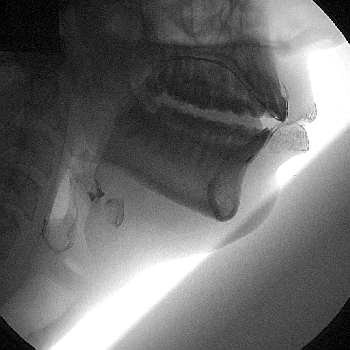
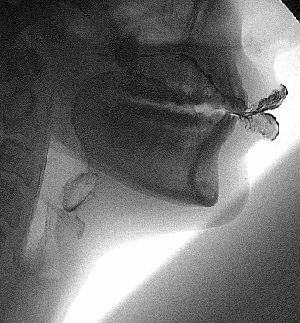
XRay Speech Analysis

While browsing animation resources I came across Christine Ericsdotter's XRay analyses of the human head in motion.
These 2 sequences show the placement of the jaw and teeth in the head while talking and opening the mouth, they have already aided my rigging and I imagine could help many other animators/modellers/riggers.
Hope these are helpful to people.

The link for the GIFs with motion is: http://hundertmarkblog.de/christine-ericsdotter-x-ray-analyses-of-speech/
Enjoy!

Tripp Hudson - Framestore

Apologies for not posting sooner but anyhow here are the notes I took from Framestore's talk at Animex with representative Tripp Hudson, the Senior VFX Producer.  The talk was focussed particularly on the studio's contributions to the recent blockbuster Avatar.


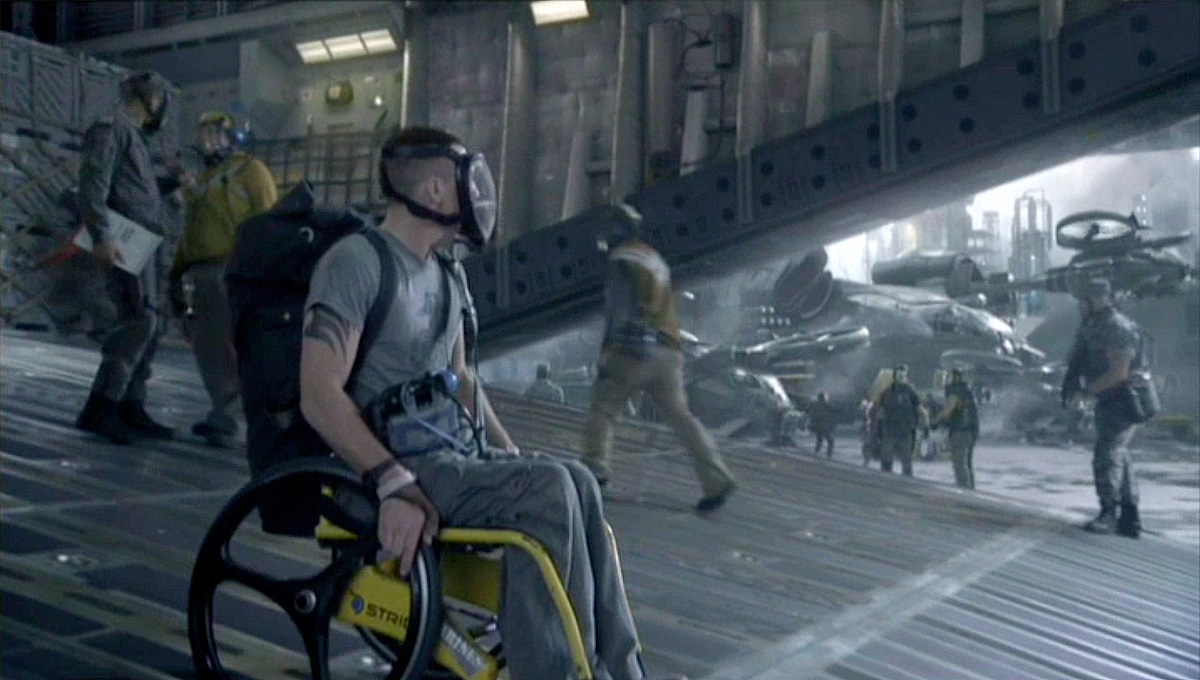
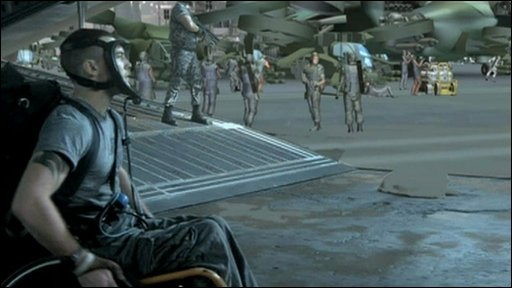
Framestore retrieved incomplete and in some case untouched scenes from WETA workshop, the studio responsible for Lord of the Rings and District 9.  The workload was too high for WETA alone so Framestore jumped on board project.  Avatar was filmed in stereoscopic this meant matchmoving twice, animating twice and rendering twice to create the desired effect this was an an epic task.  The introductory shots to the planet "pandora" including the interior dropship shots and the landing of the dropship at basecamp were Framestores responsibility as well as the first shots of the tank like human exoskeletons.

 The visors in the interior dropship shots were perhaps the most simple of Framestore's duties with their addition of reflective visors on the corp's helmets however this still meant carefully calculated reflection information. On the basecamp shots over 400 assets needed to be tracked and composited including digi-double soldiers, buildings and vehicles. The sheer scale and detailing of this production meant this one shot required even distant buildings to be modelled inside out at photo realistic level.  Obviously with this amount of detail a substantial number of layers were rendered and required for effective compositing of the final edit.


In production "Dailys" was a term given to the daily previews of the composites which were in progress.  These were arranged so that the team could assess very regularly the progression of a shot,  prototype 3D glasses were worn that allowed an unfinished shot three dimensionality.  James Cameron as a director was praised by Framestore, his technical knowledge of occlusion and render composites was extraordinary for a man of his position.  Contact between the studio and Cameron was via satellite link video meetings scheduled at awkward times where the London and L.A time difference meant staff presenting in the early hours of the morning.  Nuke and Maya were the major softwares used by Framestore in the production of Avatar, showing just how much potential these programmes have.

The Framestore talk was not very long but I felt that I managed to note down most of what was said.  If anyone wishes to delve further into the Framestore contributions to Avatar or purely the company and its other work the studio's site holds alot of cool info: http://www.framestore-cfc.com/
I also have a link to brilliant BBC coverage featuring Tripp Hudson of Framestore showing, at a basic level, how shots were created for Avatar.

I Hope to put up my Blue Sky notes soon, a brilliant talk so keep an eye out for Michael Deffeo on my next Animex based post.

Monday, 22 March 2010

Hans Rijpkema - Rhythm and Hues

Hans Rijpkema represented Rhythm and Hues, the leading Visual Effects Studio, at Animex 2010.


The talk shed light on their upcoming projects and the expansion of the studio from LA to Mumbai and Kuala Lumpur.  Rhythm and Hues have 22 years experience in the industry and have contributed heavily to the industry standard of VFX today.  Currently the studio, amongst many other projects, are in the process of creating a Yogi Bear feature and putting the final touches on the blockbuster reinvention of the A-team.

 Rhythm and Hues are in a changing Industry, the bar has been raised and now more complex characters, higher photo realism, shorter time frames and increasingly detailed backgrounds are all a film necessity.  These factors require the studio to change its approach and the working style they use, these 3 key points help them determine their production cycles:
  • Technical Capabilites
  • Audience Expectations
  • Client Expectations ( these points directly influence one another)
Production cycles vary from production to production, they grow and shrink depending on dedicated workforce size and deadlines.  It is hard for studios to maintain a talent pool and over half of Rhythm and Hues workforce are contracted freelancers on temporary contracts.  This allows the studio to get out of company health care plans for freelance artists.  Another way in which they avoid health care costs is by outsourcing to England and it's heavily built VFX Industry in Soho, in doing this there are also tax incentives in the form of rebates.  The industry, which was focussed in Hollywood and the Bay area in LA, is now global due to the financial incentives for the American film industry.  With this spread of technology comes the application of visual effects to an increasing level of productions and the growth of smaller studios into major competitors for Rhythm and Hues.

The nature of the industry has historically been the growing competition between studios in re-establishing the standard of visual effects, this prompts the giant leaps in technology we see from motion picture to motion picture.  To do this studios need to have improving technology in the pipeline being researched and tested while current technologies are in practice on current projects.  Rhythm and Hues have established new facilities abroad in India for example to allow these current technologies to be in practice and allow the LA facility to focus more on technological development. This business plan was described by Hans in great detail but in short the costs of living are considerably cheaper in the new facility's countries, lowering the cost of man-power but allowing all employees a very comfortable wage in relation to their economy.  This globalisation has meant that the search for talent has become global and therefore more artists than ever are recruited in VFX than ever before.  The rich cultures of the countries are embraced at the studios and make for new inspiration and influence on the art in visual effects.  The challenges Rhythm and Hues look to face now are:
  • a New Industry
  • Severe shortage of trained talent
  • lack of exposure at new facilities to high quality work
  • the establishment of a new facility in China
I shall most likely add to this post at a later point with more detail on Rhythm and Hues working on a global scale from facility to facility.  Some detail on what was expected from trainee staff was somewhere in my notes as well so hopefully all this will be up soon. Thanks for reading and remember to follow this blog if you are interested in the upcoming posts from Animex 2010.

Thursday, 18 March 2010

Dr Stuart Sumida - Biology Consultant "How to Train Your Dragon" (Dreamworks)

Another Stuart Sumida post and this one is specifically Dinosaur based with elements of Dragon.  Stuart was brought on board for "How To Train Your Dragon" due to his encyclopaedic knowledge of anything and everything dinosaur and their similarities to what mythically a dragon should be. With no real dragon's around Stuart was the next best thing to get Dreamwork's dragons moving realistically.


Staurt Sumida gave a talk that followed dinosaurs through animation history. starting with the most important Gerty the dinosaur by Winsor Mckay and leading on through Disney's Fantasia and "the right of spring".  Stuart remarked on how incredibly the stegosaurus's back plates were precisely right in their placement in Fantasia whilst science only very recently found that they were stood in this postion after slating the film for misrepresentation on its release.  Another example of Disney prediction of science was the feathered dinosaur featured in Fantasia, now named "Archaeoptrics". Disney were the first to find feathers on dinosaurs, this is a brilliant fact that I will revel in telling people.

Jurassic Park, a major contributor to the popularity of dinosaurs in film gave new life and realism to the prehistoric reptiles.  The dinosaurs of Jurassic Park in Stuart's and of course my opinion are brilliant and the film brought fame to Raptors who were relatively unknown before.  Bob Kurtz animator of a dinosaur short in the 60's created the Mr DNA sequence for the first Jurassic park.  The Franchise did hold some inaccuracies which Stuart has spotted including the Bracheasaurus of the 1st film jumping up on its hind legs, this is physically impossible and its sheer weight would have broken its legs.  Another is the Spinosaurus of the 3rd film and its supposed conflict with the TRex.  The TRex would have owned the Spinosaur, its scale was exaggerated in the film and the creature was in fact a fish eater so would not have eaten meat.  These are interesting points but film does not always have to be accurate in its science.  Disney's CG film Dinosaur featured an Oviraptor that raided dinosaur nests and feasted on eggs.  Science has found that it's fossils, laid near eggs, were due to their nurturing of eggs and not diet. Night at the Museum was one of Stuart's best examples of dinosaur anatomy, this same TRex model was then built on by studio Rhythm and Hues when creating Land of the Lost the recent Will Ferrel film.
Stuart went on to List his top 10 Dinosaurs of Animation:
  1. Gertie
  2. Fantasia Dinosaurs
  3. Ceratopsaurs of "Dinosaur" by Disney
  4. "Grumpy" TRex of Land of the Lost
  5. TRex skeleton Night at The Museum
  6. Jurassic Park
  7. Original King Kong TRex
  8. Stop motion 10,000 years BC dinosaurs
  9. CG King Kong dinosaurs
  10. Bob Kurtz Animated Dinosaurs
So on to Dragons, although mythical these creatures are built of parts from animals we already know of.  The earliest dragon myths were on the model of a dinosaur named "Protoceratops".


We now base our Dragon concept on a hybrid of:
  • crocodiles
  • dinosaurs
  • pterosaurs
  • bats
  • birds
Crocodiles are especially special in this list due to their galloping runs. A crocodile will fly through the air as they run which is terrific reference for dragon animation due to their similarities in body shape. The film Reign of Fire focussed more on the Bird/Bat influence and ultimately produced a more graceful and wing orientated dragon.  A pet peave of dragon design for Stuart is the addition of a hook on the elbow, this is not a factor to any existing creatures anatomy and serves no purpose on the limb if it did. That concludes the little dragon information Stuart Sumida gave at this talk or at least the information i managed to jot down on paper. He finished with his personal top 5 dragons of Animation
  1. Mushu of Disney's Mulan
  2. Maleficent of Disney's Sleeping Beauty
  3. Vermithrax of Dragon Slayer
  4. Reign of Fire
  5. Hungarian Horntail of Harry Potter
I hope this interesting to people.  If anyone is thinking of creating a dinosaur or dragon for an animation then all of the resources mentioned above are invaluable. I can do my best to put you through to Stuart Sumida if you do have any design or rigging problems that you really seem stuck with. I shall post more on Dreamworks  when I eventually get to Mark Osbourne's talk in my notes.